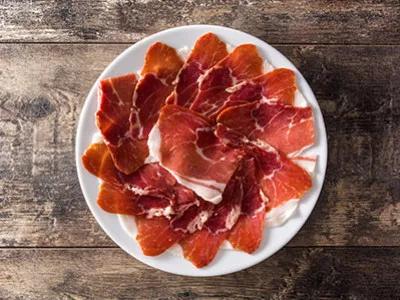
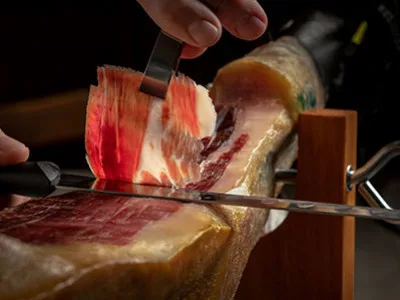
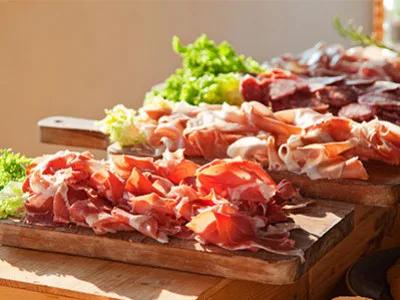
Ham, and how good it is!
Savoie Ham: everything you need to know about this regional charcuterie!
Savoie Ham is a highly prized product in France. It is particularly recognised as a very tasty and generous delicacy. The renown of this product made from pork…
12 min read· By Rémi Ledu
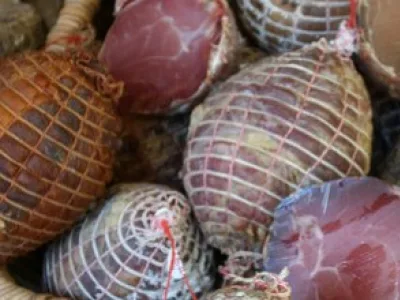
Le Jambon de Savoie: everything you need to know
The Jambon de Savoie is a much sought-after product in France. It is renowned in particular as being a very tasty and generous dish. This product made from pork needs no introduction, as its producers receive a gold medal and all manner of awards every year.
Le Jambon de Savoie
How Jambon de Savoie is made
The link between dairy cattle farming and pig farming
The production methods of Savoyard ham
The different Savoyard hams
Whether smoked, cooked or cured, however it is presented and prepared, Jambon de Savoie offers a delicious flavour that will go perfectly with the meal you are preparing. And of course, what could be better than good artisanal charcuterie made from ingredients from the Terroir. So, to find out all about Jambon de Savoie, from its production to its different types, follow us through this article.
If many French people find organic ham from Savoie tasty, it is quite simply thanks to the various techniques used by the charcutier to create this product. Indeed, it is not only saucissons or sausages, chorizo or other charcuterie that benefit from the skills of such a craftsman. Jambon de Savoie is also the result of his culinary talents.
What could be better than a good cured ham made in France to delight your taste buds and those of your guests? Whether as an aperitif or to accompany a gourmet dish, ham in all its forms is perfectly suited. And even for children's afternoon snack, you can use Jambon de Savoie in their sandwiches, with slices of tomato and cheese and a little sauce to bring it all together. It should be noted that the salt content of Jambon de Savoie is very low. Which only adds to the French people's love for this product.
What makes Jambon de Savoie stand out is the curing technique used to give it its unique flavour. What's more, the drying process after salting makes the pork used wonderfully smooth in texture. Do bear in mind that Savoyard charcuterie is among the very best, especially when you're planning an aperitif spread or a raclette.
Terroir products, whether cured ham or dry-cured ham, dry sausage, pork belly, cheeses, sausage, bacon or lardons, blood sausage or salami, are receiving a great deal of attention at the moment. Particularly in a world where protecting the environment is at the heart of every concern. The farmer who raises pigs, cows, goats, calves, ducks and hens works towards the wellbeing of the planet by limiting the production of greenhouse gases. To do so, they raise their animals outdoors, feeding them with natural produce.
As a result, artisanal ham has been very much in favour of late. Even though the end-of-year festive season is behind us, you can still plan a dinner with colleagues, family or a loved one. And of course, Jambon de Savoie absolutely must have a place at your table. To convince you to turn to good artisanal charcuterie, we'll walk you through the making and production methods of Jambon de Savoie in a few lines.
The making of Jambon de Savoie
The Savoyard country ham turns out to be a very tender ham, generous in flavour. It is a nitrite-free ham produced in the departments of Savoie and Haute-Savoie. Why in this particular geographical area? Quite simply because, historically speaking, a special area was set aside for the making of such a ham. This area is characterised by age-old practices within a mountain environment (fresh air, healthy nutrition for farm animals, and so on).
The production area for Jambon de Savoie also has other characteristics:
• A lower temperature compared with the plateaux and plains near the mountain ranges.
• Diurnal contrasts in temperature giving rise to what are known as “valley breezes”. These breezes blow down from the mountain heights towards the valley. They are ideal for drying artisanal ham.
• Abundant rainfall on the summits, meaning that the slopes are well watered.
All these combined factors make the Savoyard areas ideal for drying hams and charcuterie. Besides the natural factors favourable to the production area, there are also other factors that must be taken into account in the production of dry-cured hams.
The link between dairy cattle farming and pig farming
When it comes to fattening the pigs destined for slaughter, you should know that dairy cattle farming nearby plays a part in this. The pig feeds on whey, known as “petit lait”, which comes from cow’s milk. And to supplement this cow’s milk, farmers also give it vegetable peelings and cereals. The pig also feeds on oak leaves, which grow in abundance in this region, as well as fruit that falls from the trees.
Once the animal has become nice and fat, it is slaughtered so that charcuterie products can be made, including Jambon de Savoie. These products go through a long drying period in various places:
• In the mountains
• In sheds during the winter
Once the drying process is complete, the products can be enjoyed all year round, to the delight of little food lovers. The charcutiers put all their know-how to work to offer consumers dry-cured hams in thin slices. The same goes for the production of saucissons and sausages from the Savoie region.
Pig farming has been growing steadily over the years. It should be noted that this practice has been going on since time immemorial in Savoie and Haute-Savoie. And the pigs from which the region's delicious charcuterie is taken can be found on the alpine pastures, up in the heights and in the chalets where cheeses such as raclette, roquefort, emmental, mozzarella, comté, gruyère and parmesan are produced.
Thus, pig farming and the making of organic ham cannot be separated from one another. This is even a lovely characteristic of the Savoie departments. It's worth knowing that the Consortium des Salaisons de Savoie brings together the companies producing nitrite-free ham and other charcuterie products.
The methods used to make Savoyard ham
To make good Jambon de Savoie, a few steps need to be taken into account:
• Slaughtering the pigs. Once the pig is well fattened, it can be taken to the abattoir. Then it undergoes systematic scalding.
• The pork meat must be chosen fresh, without defects and also not too fatty.
• The ham must be cut with a rounded shape, as tradition dictates. The cut piece should weigh close to 9.5 kg. This means you can use the carcasses of heavier pigs. The meat from these parts of the animal is tender. As a result, the products obtained are wonderfully soft, even for dry-cured hams.
• Salting by hand-rubbing is the method most commonly used to salt the ham. The salting time depends on the weight of each cut piece. Dry salt should be favoured for better absorption with this type of dry-cured product. But the process generally lasts 10 days.
• A resting period in the cold is then required (for a minimum of 12 weeks). The same applies to the steaming stage and to observing the drying conditions, which are already well established.
Il convient de noter que pendant cette période de froid, le sel sec pénètre jusqu’au cœur du jambon afin que celui-ci soit salé comme il se doit. À ce moment-là, une perte d’eau de 15% au minimum peut être constatée. En fin de processus (c’est-à-dire après séchage), le jambon perd au total près de 35% d’eau, dont les 15% perdus durant la période de repos au froid.
Et une fois la prise de froid terminée, c’est alors seulement que l’étuvage peut avoir lieu. Il s’agit de mettre le jambon à l’épreuve de températures plus élevées, notamment de la vapeur. Puis, la pièce de jambon sera séchée. À noter que pour obtenir un jambon fumé, l’étuvage est remplacé par le fumage. Après le salage, le jambon peut être fumé dans la cheminée avec du bois de hêtre. Et ce, afin de donner à cette charcuterie savoyarde un goût de fumage tout en délicatesse.
Le séchage du jambon compte ensuite plusieurs mois. Pour que celui-ci soit optimal, la surveillance des jambons se fait de manière quotidienne. Le contrôle consiste à sonder et sélectionner la viande pour s’assurer que la qualité est au rendez-vous.
Lorsque le séchage touche à sa fin, les jambons sont envoyés en maturation. Durant cette période, la perte en eau n’est plus constatée. Le jambon poursuit alors son processus de maturation gustative. C’est un peu la même chose qu’avec le vin, qui reste en maturation pendant des années pour que le goût soit ensuite exquis. Pour qu’un jambon soit d’excellente qualité, il faut compter 12 mois de maturation. Bien entendu, certains jambons sont sortis plus tôt, de peur de les rendre trop secs. Cependant, pour ceux qui souhaitent garder leurs jambons en maturation pendant une longue période, il est possible de les recouvrir de pannes. Il s’agit en fait de gras de porc poivré et salé. Cela apportera davantage d’arômes au jambon, ainsi qu’une texture encore plus moelleuse.
The production of Jambon de Savoie takes nearly 240 days for hams weighing between 9 and 11 kg, and a minimum of 300 days for those weighing over 11 kg. It's also worth knowing that this ham can be flavoured. The gentle aromas obtained make all the difference compared with hams from other regions and countries, such as serrano ham (Spain), jambon ibérique or PataNegra (Spain), Parma ham (Italy), noir de Bigorre ham (in the Hautes-Pyrénées, in Occitanie), white ham or Jambon de Paris, or indeed jambon de Bayonne (in the Pyrénées-Atlantiques département). To achieve such flavours, charcutiers use Espelette pepper, grated garlic, pepper or spices. Marbled ham (jambon persillé) also smells wonderful.
The different Savoyard hams
Savoyard hams come from various cuts of pork, such as the upper ham (obtained by cutting the leg from the hind quarters) or the noix de jambon, which represents an inner section of the Jambon de Savoie and is considered to be the finest ham there is. The pieces of ham can be prepared in different ways to produce:
• Raw ham for aperitifs, tasting charcuterie, or for afternoon snacks. It can be sold on the bone or boned.
• Smoked ham. Jambons de Savoie can be smoked over beechwood. To do this, sawdust, pellets and logs are used to produce the necessary smoke.
• Cooked ham, ideal for gratin recipes, quiches, savoury melting cakes, or to accompany a roast pork.
The strength of Jambon de Savoie, whatever its shape or the treatment it has undergone? It lies in the fact that it is nitrite-free and allergen-free. To achieve this, the use of natural ferments is essential. This ensures superior quality, a stable colour and easy storage of the hams in all their forms. As you know, Jambon de Savoie can be sold in various forms, namely:
• Bone-in hams
• Boneless hams
• Whole hams
• Quarter or three-quarter hams
• Ham slices
Now, it is also important to store the Jambon de Savoie properly so that you can enjoy the product safely.
Storing Jambon de Savoie properly
To keep your ham well preserved, you should follow a few basic tips. This will help you avoid flies, insects or the appearance of mould.
Bone-in raw ham
If you have a bone-in raw ham in your possession, you need to prepare the storage area. It should be cool, at a temperature of around 10 to 15°C. It is important that the temperature remains stable and that the room is protected from sunlight or any other source of light. Cellars are ideal for this purpose. And if you have not yet started the ham, you can keep it hanging. Otherwise, place it on a suitable stand. To stop the ham from drying out, it is advisable to first remove a slice and set it aside. Once you have taken what you need from the whole ham, put the first slice back over the cut area before covering it with a clean, dry cloth. You will then be able to keep the bone-in raw ham for several months.
Boneless raw ham
Boneless raw ham can be kept for close to 10 months when vacuum-packed. But once opened, it can only be kept for a maximum of 4 months. After enjoying part of your boneless Jambon de Savoie, remember to remove it from its original packaging. It is then recommended to store it in the refrigerator.
Slices of raw ham
Ham slices cannot be kept for very long, unlike a whole cured ham. Indeed, on contact with air, they can dry out very quickly. Vacuum-packed, they can be stored in the fridge for a few weeks. If you don’t have a vacuum-sealing machine, you can use cling film to wrap the slices of cured ham and thus prevent them from drying out. You can enjoy the ham slices wrapped this way within 3 to 4 days of slicing them. Beyond this time, they may become infested with bacteria, making them harmful to eat.
To help you, producers have nonetheless put indications on the packaging: the “best before” and “use by” markings. The first is reflected in the phrase: “Best consumed before”. This is the date from which a product loses some of its flavour and provides fewer vitamins and nutrients for the body. Sometimes, from this date, the texture may also change. But this does not mean the product is dangerous for health.
As for the second marking, this is the product’s expiry date. Producers translate it as: “To be consumed by” or “To be consumed before”. Expired products, as we all know, are infested with fungi, bacteria and microbes that can be deadly to humans. It’s important to pay close attention to all these details in order to prepare an excellent recipe with Ham from Savoie.