Ham, and how good it is!
All about country ham
A charcuterie much enjoyed in both summer and winter, country ham pairs well with many foods, making it possible to create delicious recipes all year round, and with such simplicity!…
6 min read· By Rémi Ledu
Everything you need to know about country ham
Charcuterie much loved in both summer and winter, country ham pairs beautifully with a great many foods, making it possible to create delicious recipes all year round, and with the greatest of ease! Discover this essential product, along with our suggestions for gourmet country ham recipes that are easy to prepare.
What is country ham?
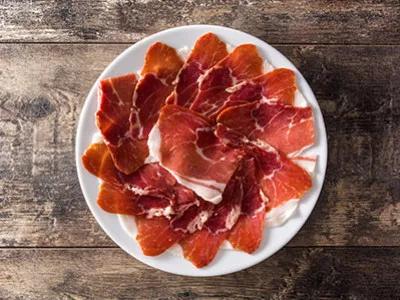
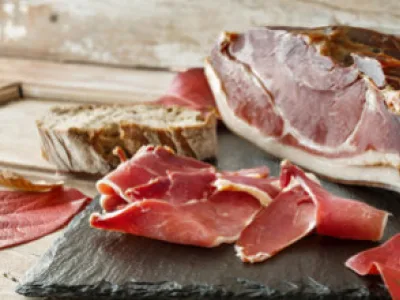
Country ham, also known as cured ham, or dry-cured ham, is a type of ham that is salted and then dried. Unlike cooked ham, which is the most widely eaten ham in France, country ham is raw and keeps very well thanks to the salt which, combined with a drying and ageing process, allows it to lose its moisture. Country ham is made from the leg of the pig, although nowadays many hams are made from other animals, game for instance. Among the best-known country hams, you'll find Serrano ham, Parma ham, Iberian ham, jambon de Bayonne, and more.
Country ham, a symbol of artisanal and traditional know-how
At Tête de Lard, we care deeply about offering you quality artisanal charcuterie, born of age-old traditions and the know-how unique to each of our producers. Country ham is a symbol of regional culinary diversity. Each region has its own traditions, its own production methods, and its own animals. An Iberian ham will not offer you the same tasting experience as a Savoie ham, a Parma ham, or indeed a Noir de Bigorre black pork ham... And that's just as it should be!
What are the different types of country ham?
First of all, many factors come into play in the difference in taste and texture between country hams. And in each case, geographical location is the main reason for this diversity. It influences several elements:
- The breed of the pigs: Indeed, depending on the geography and the type of region, we won't find the same breeds of pigs. Their living conditions won't be the same in a mountainous region as in a flat, coastal one, for example. This has an influence on their diet, their physical condition, their breed... What's more, some pigs, such as the Iberian black pork, store fat differently (intramuscularly), which gives a more marbled meat than that of other pigs. Of course, we won't get the same type of ham from a pig raised outdoors as from a pig raised on straw either. Some breeds, such as the Noir de Bigorre, benefit from a protected designation depending on their territory (PGI: protected geographical indication). This helps protect the purity of the breed while also preserving the traditional know-how of a territory.
- The climate: The climate of a territory is of the utmost importance in the making of a ham. To reveal all its flavours, the country ham goes through stages of drying and ageing, preferably in natural cellars. The moisture present in the air (hygrometry) must be rigorously controlled in order to achieve the result sought by the various producers. This is why some regions are more suited than others to making country ham!
- The ageing process: Ageing is a crucial stage in the preparation of country ham. Hung in an ageing cellar, with a relatively high humidity level, the ham will develop its natural bloom, which gives the product all its flavour. Depending on the climate, and notably the humidity, as well as the length of ageing, the bloom, which is a mould, will not be the same. In some regions it is white, while in others it can be brown. This is what gives each country ham its own particular character, much like cheese!
So there is a whole host of country hams to enjoy, depending on the producers and regions. Country ham is a true culinary symbol and a work of craftsmanship! Among these different hams, here is a selection of the best artisanal country hams to discover by region (this is not a ranking):
| Ham | Region |
|---|---|
| Jambon de Parme | Province of Parma, Italy |
| Jambon Serrano | Spain |
| Jambon de Bayonne | Béarn |
| Jambon San Daniele | Italy |
| Jambon de Porc Noir de Bigorre | French Pyrenees |
| Iberian ham (bellota, cebo de campo...) | Iberian Peninsula, Spain |
| Jambon Mangalitza | Ardèche |
| Jambon de Savoie | Savoie |
| Jambon de Lacaune | Tarn |
There are many other types of artisanal and traditional country hams, made by different producers, but these are the best known. Ham is a product with strong regional diversity, particularly in France, Italy and Spain, and it is the symbol of our regions' know-how. You can indeed find many of these hams in our dedicated category: Charcuterie >Hams!
Country ham: a product of the terroir, a symbol of conviviality
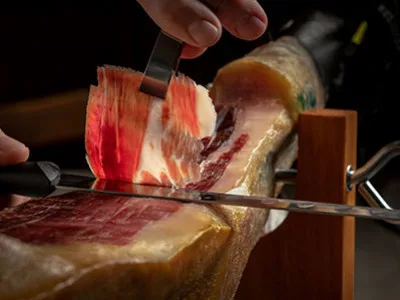
Summer and winter alike, country ham represents conviviality. A charcuterie board to share on the terrace, a raclette among friends, carving a whole ham for tasting... Just like saucisson, it is a product that brings people together, whether as an aperitif or a starter, rich in tradition and representative of a terroir.
What can you do with country ham?
While the greediest among us, like ourselves, will love eating country ham just as it is, there is a multitude of possibilities for enjoying a ham. If you choose to savour an Iberian ham, then this product, considered the finest ham in the world, is best enjoyed on its own, at room temperature. But for other types of country ham, such as Jambon Serrano, all sorts of pairings and recipes can be created to appreciate its flavours. Here are a few simple recipe ideas to make with country ham:
- The essential: jambon de pays and melon. This pairing is a classic, and there's nothing simpler to prepare. Both delicious and refreshing, this recipe makes for an ideal starter on sunny days! But for a touch more originality, you could prepare it as a salad, with Mozzarella, basil, peaches, raw vegetables... Let your imagination run free!
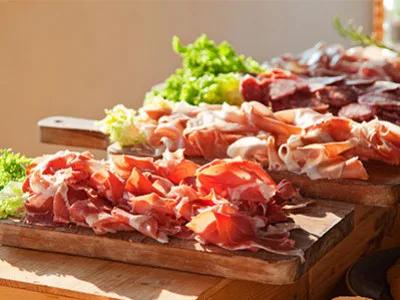
- The charcuterie board to share: Nothing could be more straightforward, but a charcuterie board accompanied by gherkins, bread and butter or cheese, and there you have it. A sharing board that's ever so popular, equally at home as a nibble with drinks or as a starter! Jambon de pays, saucisson, filet mignon... Put together your board just as you fancy, and treat yourself.
- Jambon de pays rolls: place a little ricotta, or any other soft cheese, in the hollow of your slice of jambon de pays and roll it up. Perfect for nibbling, this is a simple yet effective appetiser!
- Pasta bake with parmesan, tomatoes and jambon de pays
- Vegetables and jambon de pays: ham pairs beautifully with all sorts of vegetables, particularly leafy ones such as lettuce, spinach... In fact, you can pair jambon de pays with a whole host of foods. You can also add it to a tart, a soup, a pizza, a quiche... Whether served as tapas, a main course or a starter, it will always find its place.