Ham, and how good it is!
The Pata Negra!
The Pata Negra belongs to the category of Iberian hams. It is considered to be the finest ham in the world. Known to all for its exquisite flavours, its production remains, still,…
15 min read· By Rémi Ledu
Find all our Iberian products and Pata Negra hams within our charcuterie from Spain section.
Pata Negra belongs to the category of Iberian hams. It is considered to be the finest ham in the world. Known to all for its exquisite flavours, its production method remains, even today, little understood.
Enjoying Pata Negra
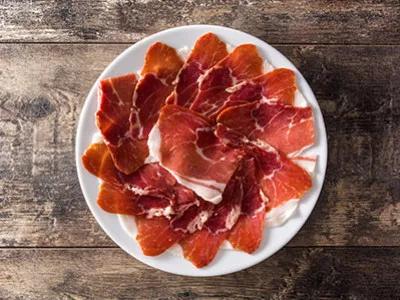
A good Pata Negra ham has rich, powerful aromas, a wonderfully supple texture and a finish that lingers for several minutes, dominated by notes of woodland undergrowth, moss, and above all hazelnut. It is best enjoyed in very fine slices of meat, keeping the fat on, which is equally delicious. What one seeks in a Pata Negra ham, above all, is its intense flavour.
Whole, it can be kept for many years. Once you begin slicing it, if you cover it with a cloth and keep it somewhere very cool, it will keep for around two months. If you cut it into slices, it will keep for a few days in the fridge.
This is a ham that pairs beautifully with many foods. It can be enjoyed very simply with bread and a good French cheese, or in more original sweet-savoury recipes, for example.
A fine ham also deserves to be accompanied by a well-chosen drink that will bring out its exceptional flavours.
- Ham can be paired with various wines or spirits, provided they are chosen with care. White wine is not the best choice, as it tends to be too young and too fruity, though Chardonnays can still do the trick. Over time, they develop notes of woodland undergrowth and mushroom that echo the flavour of Pata Negra ham
- Rosé wines, on the other hand, should be avoided, as their flavours do not sit well with those of the ham.
- Young red wines pair beautifully; choose one with powerful aromas.
- Aged red wines are the best choice of all. Look for a wine where the woody notes do not overpower the wine's aromas, and where the acidity is strong enough to stand up to the richness of the Iberian ham's fat.
- As a general rule, sweet wines should be avoided, as they are too sugary.
- For something more original, this ham can be paired with champagne. It should be aged 15 months or more and preferably brut. The ham's ageing will guide you towards the champagne's ageing, as the two go hand in hand. The bubbles bring a freshness that contrasts beautifully with the richness of the Pata Negra.
- For the more adventurous among you, sake is another possibility. This spirit, distilled from rice and possessing a unique flavour, cleanses the palate nicely, which enhances and prolongs the pleasure of tasting the ham.
Rearing
This ham with the black label is the only one entitled to bear the name Pata Negra ham, a guarantee of purity. But how are these pigs reared?
This particular breed of pig gave its name to this exceptional ham. Indeed, this pig is distinguished by its black colouring. It is a species unique in the world, and this animal has the ability to infiltrate fat into the muscle, which makes its meat richer and therefore of higher quality.
Given its size, its snout, but more particularly its general appearance and behaviour, it becomes clear that its ancestor is the wild boar. Farmers of the time were able to begin domesticating this wild animal as they became settled. People needed a source of protein available throughout the year.
They simply took the piglets away from their parents so that they could adapt to a human environment. The pigs were therefore kept in captivity from a very young age, then selected according to their characteristics. Today, this animal can weigh around 170 kilos.
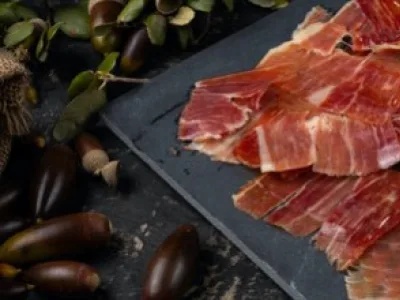
These animals, recognisable by their slender hind legs, have a rather particular rearing method. They are reared normally for months, then comes the Montanera. This is a five-month process, from October to March, during which the pigs fatten up. Their only activities are sleeping and eating. The process takes place in the bodegas where the concentration of holm oaks is highest. The exceptional climate of these particular parts of Spain produces an abundance of acorns.
The pigs roam free, and tradition dictates that there should be no more than 5 pigs per hectare. At this stage, they arrive weighing around 6 kilos. During this process, they will gain a minimum of 50 kilos to reach their final weight. They walk about all day to find their food, which must consist solely of acorns. This is the most crucial stage, giving this meat its inimitable appearance and taste. This diet also gives the ham its very particular flavours.
The Making Process:
This ham has always existed, the result of a long tradition dating back to Roman times. This Spanish speciality can only be crafted by professionals, the Jamoneros.
- Once the pig has been slaughtered, it must be cut up. Here, the shoulders are taken.
- The second stage is profiling. This is the aesthetic part of the preparation. These professionals cut the shoulder into a V-shape to give it a lovely teardrop shape, and remove the excess rind on the upper part.
- Then comes the third stage, salting. This is the technique used to preserve the food, and the length of this salting period depends on the weight of the ham. It is reckoned that one kilo corresponds to one day of salting. A 13-kilo ham will therefore spend 13 days salting. During this period, the hams are covered in salt, which encourages their dehydration. They are kept in cold rooms.
- Once the salting process is complete, comes the washing and resting. The hams are washed and brushed one by one in lukewarm water. This step removes any remaining salt. The resting period allows for slow, cold drying at temperatures between zero and six degrees for about three months.
- The ham then needs drying and maturing. It goes into natural drying rooms, which are rooms fitted with open windows, so the ham can breathe in the particular air of the region it is in. This stage allows the infiltrated fat to melt naturally, achieving an even distribution.
- Cette partie de la fabrication terminée, les pièces de jambon sont triées par poids, par forme puis sont placées dans des caves naturelles pour effectuer la dernière étape de fabrication. La température doit impérativement rester stable pour le séchage qui peut durer de 36 à 48 mois. Cet affinage va laisser l'eau s'évaporer lentement du jambon pour laisser place a des saveurs concentrés. Lors de cette période, le jambon va perdre environ 40 % de son poids.
Comme vous l'aurez compris, c'est un jambon qui demande une patience extrême, un savoir-faire particulier, une combinaison d'éléments comme le lieu, le temps, le climat qui va permettre la confection de ce produit d'exception.
Learn how to carve your ham
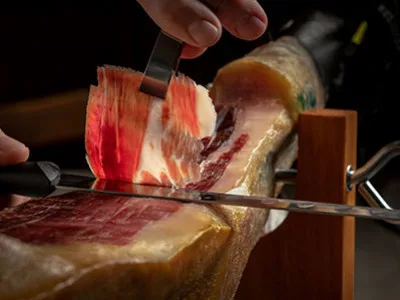
Once your ham is home, you'll need to learn how to carve it. It's an art within everyone's reach. However, do bear in mind that everything we do to the ham will influence its flavour. Your knife must be sharpened to perfection. Do be careful not to cut yourself.
You should position the hoof upwards, then use a good knife to remove the surface fat. This step, opening up the ham, should not be done across the whole piece; you should leave only an opening, which will be covered again as soon as the tasting is finished, to preserve those delicate flavours. This is a step where gentleness is essential. Once this layer has been removed from the top and sides of the piece, the flesh will appear. Still using a well-sharpened knife, cut very thin slices with the knife held almost parallel to the ham. All that's left to do is enjoy it!
The most expensive ham in the world
Pata Negra ham is considered to be the finest in the world, so it stands to reason that the most expensive ham in the world is a Pata Negra. The man behind this feat is Eduardo Donato. He has lived in a small village, Cortega, in south-west Spain for 26 years.
Its price of around €4,000 is justified by:
- The way the pigs are raised. Indeed, these pigs lead “a life of luxury”. The rearing is 100% ecological, respecting both our planet and the animal. The animals are extremely closely monitored, and even benefit from homeopathic care to guarantee unique quality. If an animal is injured, it is healed naturally with olive oil, mint, and so on. These practices naturally come at no small price. They are also raised in very large spaces where they can eat more than double the quantity of acorns compared to other pig farms. You may rest assured, however, that no chemical product will ever come into contact with these animals that will go on to produce this famous ham.
- The guarantee of a 100% pure breed. Eduardo Donato rears a variety of pork unique in the world: El Manchado pur ibérico de Jabugo, a breed on the verge of extinction, with only a few hundred remaining today. It was a breed rather looked down upon a few decades ago, and it even nearly disappeared as it was considered of poor quality. Eduardo Donato's house carries out DNA tests on all the pigs to ensure their purity. He is a passionate breeder who therefore decided to save this breed and restore its noble reputation.
- The small quantity sold each year: the producer creates scarcity. Indeed, only 80 are sold per year. To enjoy one, you need to plan well in advance. It is a much sought-after product, one where price becomes a secondary concern.
- The time taken to make it. The producer follows a lengthy three-year process to achieve a long, traditional ageing.
- The flavours. Developed over many years, this is naturally the strength of this ham. Its taste is only lightly salted, almost sweet, with unique aromas. Everyone who tastes it says they experience unique, very intense taste sensations, a true explosion of flavour on the palate.
It also contains proteins and minerals. It is rich in unsaturated fatty acids, vitamins B1 and B6, and provides 180 to 190 calories per 100 grams. It is a true gem, both nutritionally and in terms of taste.
The aim here, then, was to create a ham that is perfect in every respect.
There are, however, much more affordable Pata Negra hams, such as those from the Redondo Iglesias house. You can find hams for around €500. Everyone can find their own Pata Negra ham, and the one that suits you best isn't necessarily the most expensive one. At this level, they're all excellent. These are products to taste at least once in your lifetime.
The different varieties
As mentioned above, Pata Negra ham belongs to the family of Iberian hams, and it's considered the finest, even though the others shouldn't be overlooked either.
There are different "Pata Negra" hams, distinguished by coloured labels (Black, Red, Green and White). The black label corresponds to true Pata Negra; this ham must come from 100% Iberian meat, reared as tradition demands.
The classification of these hams depends on the breed of the pig and the quantity of acorns consumed. There are, in total, four types of Iberian ham.
- The first, which you already know, is Pata Negra, from 100% Iberian pigs raised freely and fed exclusively on acorns. (black label)
- The second type, Bellota, comes from pigs that are 50 to 75% Iberian. It too is raised outdoors, freely, during the montanera. During this period, it feeds on acorns and grasses. It's identified by a red label.
- The third type is Cebo de Campo Iberian ham. It comes from pigs that are 50 to 75% Iberian breed. It's raised freely and fed a mixed diet of acorns and supplements such as cereals and vegetables.
- The fourth type is Cebo ham, from pigs that are 50 to 75% Iberian breed. It's raised freely and fed on natural fodder and cereals. It's identified by a white label.
Spain is therefore the heartland of these hams, but above all it's the required place to obtain the famous protected designation of origin certification. Pata Negra hams can be produced in any bodega in the country, but there are only four recognised, certified regions.
- The first is Extremadura. Located in the south-west of the country, it is renowned for its famous cork oaks, essential for rearing the pigs. It brings together many of the conditions needed for rearing Iberian pigs, which makes it one of the places where Pata Negra is produced.
- The second is the Province of Huelva, and more particularly the village of Jabugo. This place is called the cradle of Iberian ham. This exceptional appellation still works wonders, as it is there that the finest ham in the world is produced.
- The third is the oldest of the controlled appellations, the Guijuelo region. The flavours of this ham are often compared to the local inhabitants. Their shared trait? A strong character.
- The fourth and final region is the Los Pedroches valley. It is a very natural setting, with many meadows perfectly suited to rearing the Iberian pig.
This ham, celebrated for all its many qualities, is nevertheless, today, at the heart of a debate. The Spanish government wants to relax the production rules for Pata Negra ham, which is naturally not to the liking of producers. It is becoming increasingly common to hear that the finest Pata Negra ham does not necessarily come from 100% Iberian pigs. More and more producers are mixing breeds, which produces hams that are certainly different, but just as good. This relaxation of the rules has therefore allowed the sector to open up, diversify and, who knows, perhaps even improve. However, Spanish producers fear that some foreign producers might sell 100% Iberian ham in Spain. There are already worrying practices, such as two Spanish producers who have started selling Iberian pork reared in the United States. This is a growing insecurity for farmers who would welcome a Protected Geographical Indication (PGI), but not at the expense of the value of their own labels. Such confusion can sow doubt in the mind of the consumer, which is simply not acceptable for products of this standard. This is therefore a matter the Spanish government will need to resolve quickly, so as not to damage a sector so important to the country.
Despite these disputes over protected designations of origin, a fine ham can be produced anywhere; one must keep an open mind to new discoveries, to different producers, even French ones, such as Patrick Duler. Indeed, his ham won a blind tasting held in Barcelona. Everyone must find the ham that suits them best.
Recipes:
A Pata Negra, Parmesan and Rocket Risotto:
For 4 people, in 30 minutes.
You will need:
- 300g risotto rice
- 1L hot vegetable stock
- 1 onion
- 4 slices of Pata Negra ham
- 80g Parmesan
- 1 handful of rocket
- 10g butter
- 10cl white wine
- Salt, pepper
- Olive oil
For the preparation,
First, peel and finely slice the onion. Then cut the Pata Negra ham into pieces.
Next, take a pan with a little oil in the bottom and sweat the onion. Add the rice and cook it for a few minutes until the rice turns translucent. Then deglaze everything with the white wine and let all the liquid evaporate.
Thirdly, add a ladleful of your hot vegetable stock and stir regularly. Once the liquid has been fully absorbed again, add more stock, and continue in this way until the rice is cooked. This should take between 14 and 18 minutes. It is important never to stop stirring.
Finally, at the end of cooking, add the Pata Negra ham, stir, then fold in the Parmesan and butter. Season with salt and pepper and serve immediately!
This is a warm, family-friendly recipe that will delight everyone at the table. Very simple and quick to make, it will please seasoned cooks and beginners alike.
Today we offer you a second recipe, perfect for quick winter meals. It will warm the hearts and taste buds of your guests.
Grilled Pata Negra open sandwiches:
For 7 people, in 35 minutes:
You will need:
- 7 individual bread rolls
- 5 eggs
- 100g Iberian ham
- 80g single cream
- 40g grated Parmesan
- 40g grated cheese
- A pinch of finely chopped mixed herbs
- Salt, pepper.
For the preparation,
To begin, cut into the small rolls with a knife on the top. This cut should be oval-shaped. Remove the crust, then the crumb.
Preheat your oven to 200°.
In a mixing bowl, whisk the eggs with the cream and add the parmesan as well as the grated cheese. Once well mixed, add the chopped herbs and the Iberian ham cut into small pieces. Season with salt and pepper, then mix gently.
Once this first preparation is ready, spoon it into the hollowed-out rolls. Place these rolls in an oven dish and bake for 20 to 25 minutes. At the end of cooking, the rolls and the filling should be nicely golden.
As soon as they come out of the oven, serve them straight away with a salad and impress your guests.
Finally, for this third and last recipe, let's make the most of autumn and its bounty to treat ourselves.
Pan-fried porcini mushrooms with Pata Negra:
Serves 2:
You will need:
- 600g porcini mushrooms
- 8 slices of Pata Negra
- 1 shallot
- 1 Knorr roast juice stock cube
- 1 knob of butter
- 1/2 tablespoon of olive oil
- Pepper
- Chives and parsley
For the preparation,
First, trim the earthy end of the porcini mushrooms, then clean them and cut them into cubes.
Next, peel and finely chop the shallot, wash and chop the parsley and chives.
Take a nice hot pan and melt the knob of butter with the olive oil. Fry the porcini mushrooms and shallot over a high heat for 5 minutes.
Then add the stock cube, chives and parsley. Season with pepper and leave to simmer for a further 2 minutes.
Take another pan and fry the Iberian ham for around thirty seconds. Place this ham on top of your porcini mushrooms, then serve piping hot.
This simple yet impressive recipe will delight your whole family.