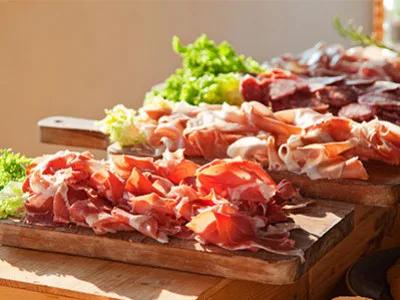
Ham, and how good it is!
Iberian Ham
Iberian pork is a true national treasure for the people of the Iberian peninsula. This breed follows a unique rearing method to ensure the quality of pata negra ham.
12 min read· By Rémi Ledu
CONTENTS
Ecological rearing
The importance of feed
Production of Spanish Pata Negra Ham
Curing
Artisanal drying of Iberian hams
Maturation
Quality
Characteristics of pata negra ham
The different cuts of the ham
How to store and best enjoy an iberico pata negra ham
Carving Iberian ham in pictures
Nutritional value
The Iberian pig is a true national treasure for the people of the Iberian peninsula. This breed follows a unique rearing method to ensure the quality of pata negra ham.
Ecological rearing
The pig destined for the production of bellota ham follows a particular rearing method divided into two phases: a preparation phase followed by a fattening stage. The first begins as soon as weaning ends. It consists of letting the animal feed freely outdoors in meadows and woodland.
This semi-free phase allows the Iberian pig to feed on grasses, bellota (acorns) and bulbs. After a year, it reaches a weight of 90 to 110 kilograms. The pig is then placed in an enclosure and the fattening phase begins.
The importance of feed
The fattening period often coincides with the montañera. During this period, acorns fall from the oak trees, providing a prime source of food for the Iberian pigs. Generally, each animal gorges itself on 10 to 15 kilos of acorns a day, which allows it to increase its weight by 50%.
The oil from the acorns gives off a hazelnut aroma that seeps through the muscles of the Iberian pig. It is this aroma that gives patanegra its unique taste and fragrance. Besides its inimitable flavour, the ham obtained from this type of pig is also a wholesome product thanks to its richness in vitamins and minerals.
Production of Spanish Pata Negra Ham
The pig is cut up and branded with a hot iron during the week of the "sacrifice". This operation is carried out in one of the cutting rooms overseen by health inspectors, to guarantee the hygiene of the process. The hams are trimmed in the "serrana" style (a traditional know-how from the Huelva region), then placed in an airy room known as the "cámara de oreo".
Salting
In the salting room, the hams are stacked one on top of another, separated only by a thin layer of salt. They remain there for a period proportional to their weight (roughly one day per kilo), at a temperature of 1º to 5ºC and a humidity level of between 80 and 90%. This is a fundamental stage on which the quality of the ham depends. The ham must never be too salty; on the contrary, it should be gentle on the palate.
Once the time in the salting room is over, any remaining salt is removed from the surface of the ham. It is then left to rest for 35 to 60 days at a temperature of 3 to 6ºC and a humidity level of 80 to 90%.
Artisanal drying of Iberian hams
The hams are hung to dry in the open air so that the moisture they contain gradually disappears. The temperature (15º to 30ºC) and ventilation must be carefully controlled. This drying period, lasting six to nine months, is when the ham "perspires" under the summer heat. It allows the fat to spread throughout, giving the ham its juicy, flavoursome flesh.
Maturing
To achieve a slow maturation, the hams are placed in the "bodegas", where it is essential to maintain a constant temperature and humidity. This final stage usually begins in autumn and continues for ten to twelve months. During this time, moulds appear on the outer surface of the ham, giving rise to its aroma and flavour (bouquet).
When the ham leaves the "bodega", its quality is checked. A tester (in fact a bone) is used for this purpose: once inserted and then withdrawn from the ham, it should release a scent that is both pleasant and pronounced. Over the course of this long process, the ham will have lost between 30 and 35% of its initial weight.
The ham obtained in this way is of a truly unique quality. It has been prized by gourmets the world over since Roman times.
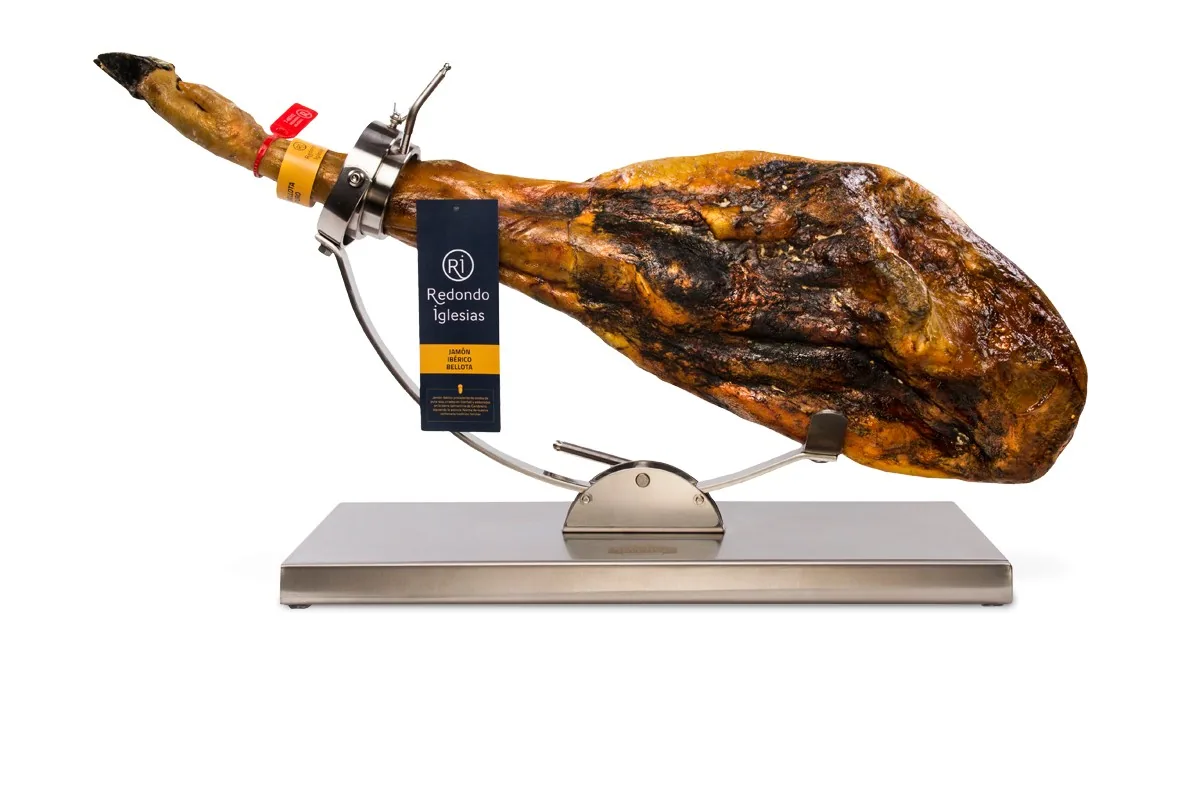
The Iberian ham is finer and more elongated than other hams. Iberian ham is also characterised by a diamond shape and an outer layer of pale yellow fat that feels fine to the touch. The colour of the flesh ranges from dark pink to red, the aroma is pleasant, the taste mildly salty and almost sweet, the texture only lightly fibrous, and the soft fat melts in your hand.
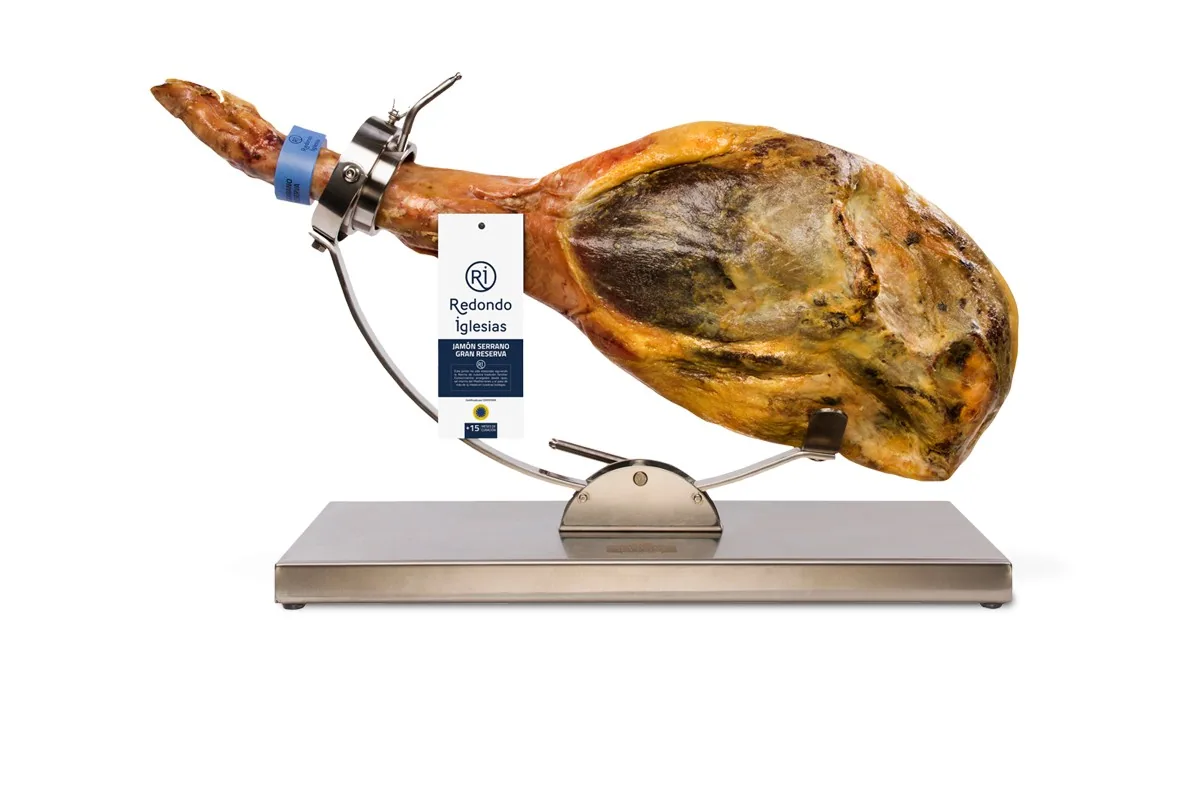
- "Ibérico" Ham and Shoulder come from the Iberian breed pig fed with grains authorised by the Regulatory Council. They can be identified by a red label.
- "Etiqueta Negra" Ham and Shoulder come from the Iberian pig raised in "montanera" (free-range) on acorns and wild herbs, with feed supplemented by grains authorised by the Regulatory Council. They can be identified by a black label.
- "Bellota" Iberian Ham and Shoulder, "the crème de la crème", also come from the Iberian pig raised in "montanera" (free-range) but fed exclusively on acorns and wild herbs. They can be identified by a black and gold label bearing the word "Bellota".
Quality
Quality controls are necessary to guarantee consumers the finest products, certified by the quality label. To this end, producers rely on the appropriate technical control and monitoring services, such as a qualification committee. These controls are applied at every stage of the ham-making process: marking of the animal, verification of origin, feeding, rearing conditions, ham production, final labelling, and so on. It is precisely this rigour that certifies its quality!
Characteristics of pata negra ham
Hams are classified by year. Each year corresponds to the moment the pig is slaughtered.
You can recognise Iberian ham by the following :
- The leg is slender and the silhouette elegant
- They are always longer than they are wide
- The outer surface is covered in white or grey-blue yeasts and moulds, characteristic of the slow maturing process in the bodegas
- When sliced, you can see plenty of fatty marbling
- The colour of the flesh ranges from pink to dark red depending on the length of ageing
- They have a glossy appearance thanks to the oil from the acorns
The different parts of the ham
Let's now talk about the different parts you can find on a jambon serrano or on a pata negra ham.
The ham is made up of 4 main parts:
1- This area is called the contamazana in French: the sous noix. This area is thinner than area 2, which is why it's best to start with the sous-noix if you wish to carve your ham over more than 5 days, as this will prevent it from drying out even more.
2- This area is called the maza in French: the noix. This part of the ham is the meatiest part, which is why, if you wish to cut into your ham quickly (less than 5 days), we recommend starting with this area, with the hoof turned upwards.
3- This area is called the shank; ideally, cut the meat into large cubes for a soup, for example, or a good omelette.
4- Finally, this area is called the Punta; you can carve it once you've completely cut through areas 1 and 2. This area is fattier, but still yields meat that is just as flavoursome.
How to store and make the most of a pata negra ibérico ham
If you plan to enjoy it over several sittings (more than 2 days):
- Carving should begin with the hoof pointing downwards, so as to access the driest part of the ham (which, for this reason, should be eaten first). You'll then turn the ham over, hoof pointing upwards, to "tackle" the other, juicier part.
- Remove the rind little by little, to prevent the ham from drying out.
- The cut ("exposed") part should always be protected with a slice of rind or with kitchen paper.
- Only cut what you'll be able to eat.
For optimal flavour and enjoyment of the ham, cut it into thin, almost transparent slices using a knife with a fine, long and very sharp blade.
A poor cut can genuinely spoil the tasting experience of the ham.
Iberian ham should not be eaten cold and should therefore be kept at room temperature, otherwise it loses its flavour.
1 - Remove all the wrapping around the ham, whether paper, plastic or cloth. Bear in mind that the ham is still "alive", right up until the day it is eaten. Store it somewhere cool, away from direct sunlight, if you are not going to open it straight away. Ideally, it should be hung and not touching any other surfaces.
2 – Mainly when you first start carving, the ham has a generous layer of fat; the very first outer layer is yellow and not fit to eat, but the white fat beneath it can be used in cooking if you wish. You need to work your way down until you reach the first layer of lean meat. This fat is aromatic, flavoursome and delicately refined – the very finest of animal fats. If you are not going to use it straight away, you can keep it wrapped in foil in the fridge to cook with later on. By the time you finish your ham, you will be glad you did not throw it away.
3 - If you think you will not be carving the ham for a long while, it is best, before it dries out completely, to slice it all up and take it somewhere it can be vacuum-packed into portions for you.
4 - Try to prevent the ham from drying out, so that you do not have to throw away the first slice each time you come back to it. To do this, use the outer layer of fat that you removed when you first began carving. Place it over the cut surface, as it will keep the air out and keep the ham nicely lubricated. You can secure it in place with a cocktail stick to make sure it stays put. If several days go by without carving, rub it over from time to time to keep it well lubricated. Make sure the fat covers the whole of the cut surface, so that the oxygen does not dry the ham out.
5 - In ham-carving competitions, among other things, the weight of each portion is assessed. Plates must be presented impeccably, with exactly 100 grams of ham. Try to cut very thin, almost transparent slices – this way, none of the ham will go to waste, and it will taste all the better for it. To be enjoyed at its very best, ham needs to be sliced very thinly; this is essential, as even the finest quality ham will not taste as good if the slices are too thick.
6 - if you follow our advice, you will be able to make the very most of your ham.
Try to make the cutting surface nice and straight and horizontal by working around the hip bone to easily access the flesh around it with the knife.
7 – Cut slices that are half flesh and half fat in the areas where the fat is more abundant, and mix these slices on the plate with the others. Do not dive only into the flesh, as you would lose the recommended straight cutting surface and would feel you were missing out on real treats. Remember that fat is one of the secrets of Iberian ham and one of the reasons for its health benefits, thanks to its richness in oleic fatty acids, such as those found in olive oil. Do not give up on this animal fat, which is healthier and more beneficial than you might think.
8 - If the ham is not going to be eaten quickly, never remove all the rind. Do it gradually as you work your way across the cutting surface. The skin and fat prevent the surface of the sides from hardening due to contact with the air.
9 - Always try to work out the amount of ham you are going to eat and do not cut more than that. If any is left over, cover it with a plate or a sheet of paper to stop it drying out and keep it at room temperature until the following day.
10 – Finally, you can make small cubes from the parts that cannot be sliced; you can eat these cubes as a nibble, or you can cook with them by adding them to omelettes, soups, etc. Once you have finished the ham, you can ask a butcher to chop it up. Or do it yourself with a small hand saw. These pieces of bone make delicious stocks. Ham bones with their marrow give stocks that touch so characteristic of Iberian products. As for the rest, you can keep it in the freezer to prevent it from turning rancid.
Carving Iberian ham in pictures
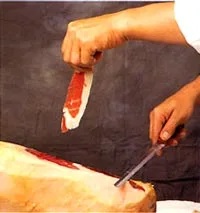
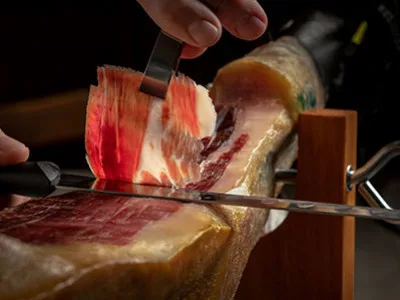
Once the area has been trimmed, you can start cutting the slices.
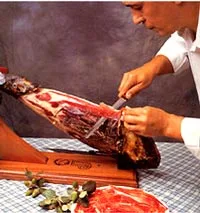
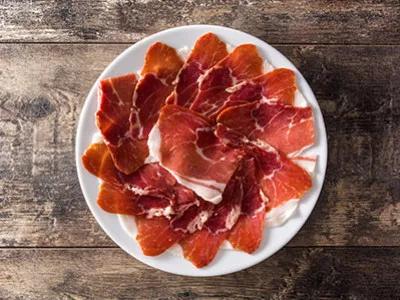
Even today, Ibérico ham remains the finest of nibbles.
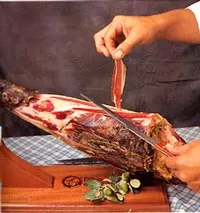
The fine veins of fat running through the ham are proof of its quality.
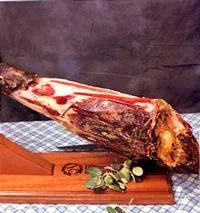
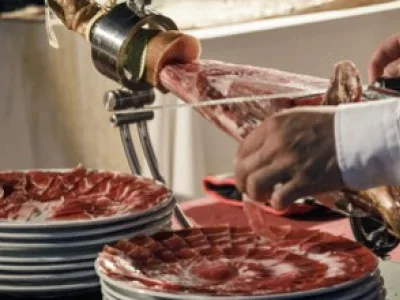
The ham should be tilted on its stand and must never be cut by machine.
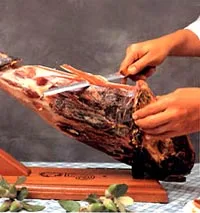
It is only by hand that one can capture the subtleties offered by the leg area.
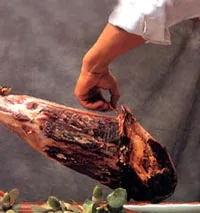
The appropriate temperature for slicing is around 12°C
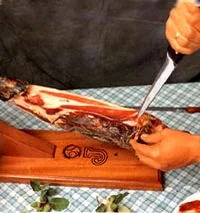
From start to finish (right down to the bone), the slicing should be carried out with great care.
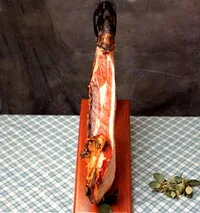
The presence of a little fat in each slice is essential.
Nutritional value
Pork has always been part of Spanish gastronomic culture. But of all the products, it is Ibérico ham that is the most prized, both for its flavour and its nutritional properties.
The latest studies in nutrition and dietetics tell us that Ibérico ham is a product rich in protein, essential for the body, and provides vitamins B1, B6, B12 and folic acid, which are beneficial for the proper functioning of our nervous system and brain.
It is also rich in minerals such as copper, iron and phosphorus, essential for bones and cartilage.
Iberian ham is also rich in oleic acid (found in the acorns eaten by the pigs), which is recognised for helping to prevent cardiovascular disease. Indeed, the Iberian pig is sometimes described as ‘an olive tree on legs’!
Finally, the high vitamin E content makes it an antioxidant-rich product. Enjoyed with tomato (on bread, for example), its antioxidant effects are doubled.
What's more, it contains only 300 kcal per 100 grams, so you can enjoy it even whilst watching your diet!