
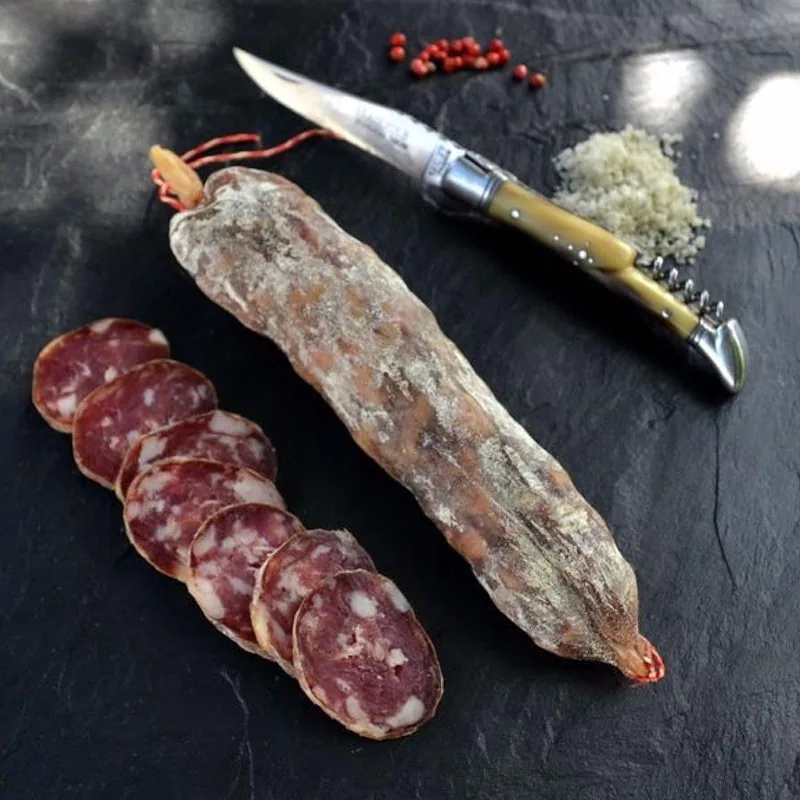
250 g
 Nitrite-free
€9.90
2 products
2 products
250 g
€9.90
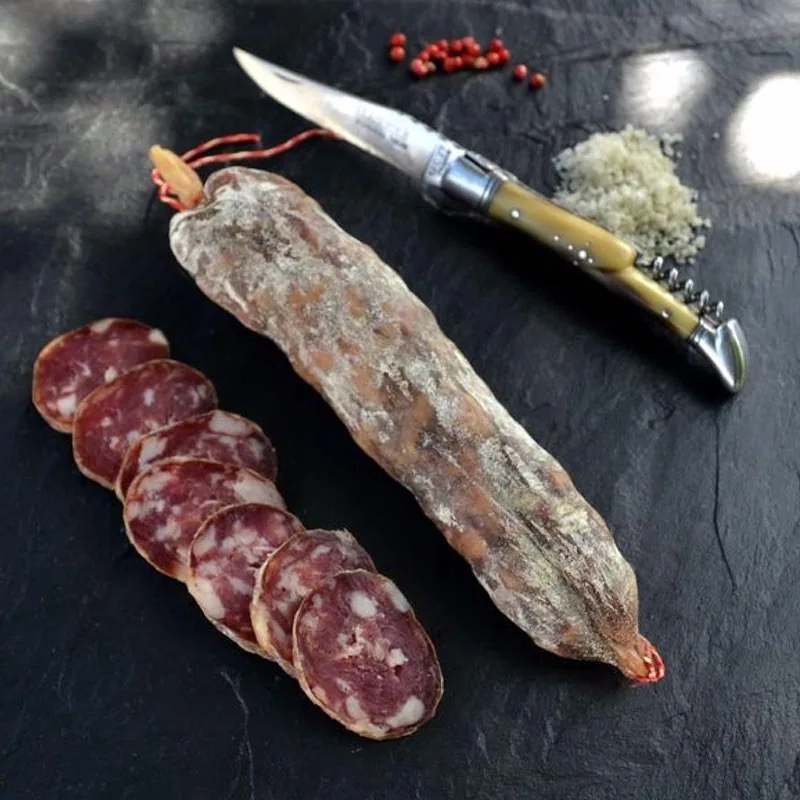
250 g
€10.90
Oh no, there's more to Auvergne than just the ASM rugby club!
Tête de Lard offers you a wide choice of charcuterie from Auvergne and Haute-Loire: saucisson, dry sausage, dry-cured filet mignon, dry-cured ham, coppa…
In this mountainous territory, renowned for its age-old volcanoes, we set off to discover the terroir. This mountain region, where water flows in abundance, where the volcano's fertile land reveals its treasures, and where the cool, damp mountain climate favours both farming and livestock rearing, opens up before us to share all its secrets. The presence of numerous volcanic plains has, throughout its history, allowed for the development of a rich agriculture, and therefore, an exceptional gastronomy. It is one of the oldest regions in France, having seen many changes: geographical changes, changes in nationality, historical changes. It is a region united by its history, by the strong sense of belonging felt by its inhabitants, but above all, what brings everyone together, is its terroir.
When it comes to charcuterie, Auvergne is brimming with specialities, each as delicious as the next. To protect this heritage, protected geographical indications have been put in place.
Let's begin with the pigs. The "Porc d'Auvergne" breed has always enjoyed a certain success. As early as Roman times, it was sought after throughout the empire. It formed the basis of the local people's diet. In the Middle Ages, it held such an important place that it lived alongside the inhabitants, in town, just like any other person. Sadly, the Auvergne breed has disappeared today, though the region remains a stronghold of pig farming. Indeed, the pig festival is still held once a year in Besse. At Tête de Lard, our producers take great care of their animals throughout their lives, rearing them with respect for animal welfare and the environment, and playing their part in upholding responsible farming and quality French livestock rearing.
The Porc d'Auvergne breed has now disappeared, but the region has created a Label Rouge "Porc Fermier d'Auvergne" which guarantees the consumer meat that is more mature than mass-market pork; indeed, the pigs must live for at least twenty-six weeks. They must be born, raised and then fattened outdoors, and slaughtered in the Auvergne. This is a guarantee of quality that has proved successful, with the entire production sold every year – there is more demand than supply, and the region would indeed welcome more farmers ready to embark on the adventure. This Label Rouge allows consumers to know the story behind what they eat, allows professionals to offer their customers quality products, but above all allows farmers to earn a decent living, to produce meat recognised by all and to pursue their passion in complete peace of mind. The farming world is in danger today, our farmers, our livestock breeders are in danger. Thanks to initiatives such as the Label Rouge "Porc fermier d'Auvergne" set up by the region, French production is given a new lease of life.
Once the meat has been transformed, the producers create exquisite charcuterie specialities. Less famous than jambon de Bayonne, Auvergne ham nevertheless has nothing to envy it. It is made according to traditional know-how, which gives it a more distinctive, more forthright flavour than Iberian hams. You can easily spot it thanks to the protected geographical indication "Jambon d'Auvergne", and there is even the "Saucisson d'Auvergne" designation. The region knows how to protect itself, how to protect its outstanding products. These labels allow us to showcase farmhouse, artisanal products, crafted according to the rules of the art.
There are many specialities built around pork. We find truffade, a lovely alternative to tartiflette, but also potato pâté, Auvergne tripou and boudin with apples. All of this should, of course, be accompanied by cheeses from the region such as St Nectaire! A real treat. And do not forget the exquisite wines to pair with these wonderful charcuterie.
Auvergne's gastronomy has a real history that we invite you to discover. Auvergne has always been a rural region, sometimes overlooked by all, sometimes set aside, yet it has many resources to offer us. Auvergne products, for a long time reserved only for the region's inhabitants because of the geographical distance, gradually made their way onto Parisian tables. The region owes this culinary exodus to the bougnats. The bougnats were Auvergnats by origin who left to live and work in Paris. These regional immigrants worked in crafts and trade. They were the largest immigrant community in our capital. They arrived in this new city with their know-how, their way of life, their gastronomy, which gradually spread through the capital, and later throughout the rest of France. Today, people enjoy Auvergne specialities such as aligot, truffade or indeed tripou all over France.
We shall detail a few regional dishes and tell you their stories.
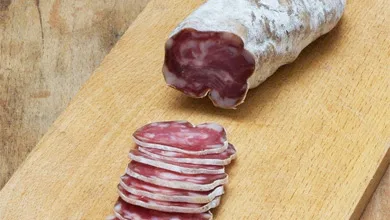
The charcuterie of Auvergne, such as saucisson sec d'auvergne, jambon d’Auvergne or dry sausage, is made in Auvergne and has benefited from IGP status — protected geographical indication — since 2016. This label guarantees that the charcuterie is 100% Auvergnat in origin! It must therefore be made within a precisely delimited geographical area, controlled down to the kilometre!
Indeed, the IGP is a European quality mark awarded when a product comes from a specific geographical area, because the reputation, characteristics and quality of that product are linked to that territory. It is a way of recognising and preserving the traditional know-how of a region. To benefit from this IGP, products must meet the specifications of the label, in addition to coming from a limited geographical area. These specifications impose a traditional presentation and production process. What's more, the Consortium des Salaisons d’Auvergne (CSA) oversees compliance with these criteria. You may rest assured: with this label, your saucisson will be truly Auvergnat!
This know-how is the fruit of the history of traditional Auvergne charcuterie, built and shaped by generations of artisans. That is why the IGP is today the guarantee of respect for the traditions of Auvergne behind these charcuteries that we love so much! If you wonder why the cured meats of Auvergne are so flavoursome, it is partly because the climate, winds and altitude of the mid-mountain region are highly conducive to rearing livestock, as well as to the drying and ageing of products. And of course, thanks to the expertise of the producers who offer us their inimitable recipes!
In order to benefit from the IGP jambon d'Auvergne, saucisson sec d'Auvergne, or indeed saucisse sèche d'Auvergne, the cured meats must come from one of these territories:
The IGP concerns the characteristics of the product, its process and its area of production, but not necessarily the origin of the raw material. That is why many Auvergne farmers rear Label Rouge Auvergne farmhouse pigs, a label guaranteeing the quality of the pork. Thus, the designation “Auvergne farmhouse pork” appears on certain cured meats in addition to the IGP, which also guarantees the origin of the raw materials. You may also find the mention “pork from the Massif Central”, guaranteeing, as its name suggests, the use of regional pork.
Respect for tradition has kept French craftsmanship alive for generations, and more specifically our precious French gastronomy. For we must admit it, the consumption of saucisson in France is sacred! Fortunately, many regions offer a renowned know-how in this field. Among them, among others, the saucisson de Savoie, the saucisson de Lyon, the saucisson du Sud-Ouest… or indeed the saucisson corse with its unmistakable flavours!
Our French producers work hard every day to reinvent themselves, whilst offering salaisons with authentic flavours that have delighted us for generations. At Tête de Lard, the future of regional farmers and producers is especially close to our hearts. Enjoy the taste of artisanal charcuterie from Auvergne and support local, fair trade commerce to help sustain our farming heritage.
To meet the requirements of the specifications and earn the IGP label, saucisson d’Auvergne must be made using traditional methods. It should also be noted that these salaisons are only made with natural casings.
Here, then, are the steps involved in making dry-cured saucisson and dry sausage from Auvergne, after the selection of “pure pork” meats:
Once finished, the saucisson is recognisable by its lovely dark colour and powerful aromas. It is a garlicky saucisson that contains less fat than other saucissons on the market.
At Tête de Lard, we work alongside Auvergne salaisonniers renowned for their know-how and the quality of their products. We are therefore delighted to offer you a selection of the best saucissons d’Auvergne online! Here is our ranking of the finest saucissons d’Auvergne IGP:
| Rank | Product / Producer |
| 1 | Saucisson sec - Salaisons E. Chavassieux |
| 2 | Thai saucisson sec - Salaisons E. Chavassieux |
| 3 | Pure pork saucisson sec - La ferme des cochons gourmands |
| 4 | Farmhouse pork saucisson sec - Maison Laborie |
| 5 | Saucisson sec - Salaisons Bernard |
| 6 | Aubrac beef and pork saucisson - La ferme des cochons gourmands |
| 7 | La fine Calabraise dry-cured sausage - Salaisons E. Chavassieux |
| 8 | La Boucanée dry-cured sausage - Salaisons E. Chavassieux |
| 9 | Thaï Fine dry-cured sausage - Salaisons E. Chavassieux |
And as a bonus, Chavassieux salaisons and la Ferme des cochons gourmands offer nitrite-free charcuterie! What's more, we're particularly fond of the originality of Emmanuel Chavassieux's salaisons. The Thai recipes are truly one-of-a-kind gems, well worth tasting!
You can find genuine traditional IGP Auvergne saucisson for sale online on our website Tête de Lard, with 24h delivery throughout France. We take great care over the delivery of your saucisson, following strict hygiene and storage procedures, from warehouse to transport! We work alongside recognised artisans to bring you quality Auvergne saucissons, and it's guaranteed 100% artisanal. To browse our Auvergne salaisons, head to our Regions category > Auvergne/Haute-Loire. We also remain at your disposal for any questions, both before and after your purchase, through our customer service team.
N.B: wondering how to recognise a traditional Auvergne saucisson? It's simple! Auvergne saucissons carry a label stating their designation, the CSA logo, and the IGP mention.