
800 g
Only 1 left in stock Nitrite-free
Le Noir de Bigorre
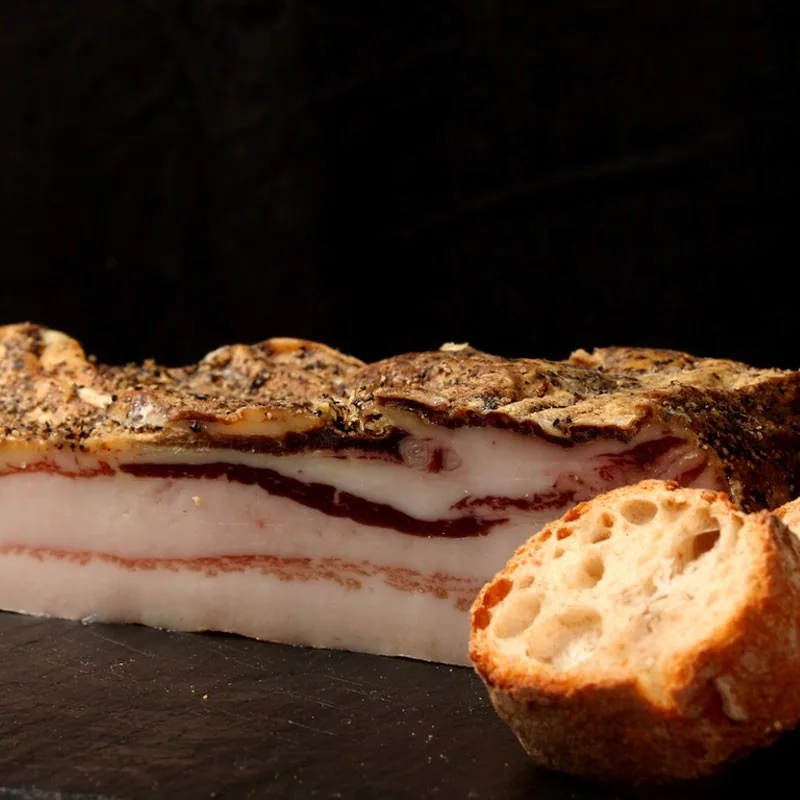
Quarter of flat Noir de Bigorre black pork ventrèche - Le Porc Noir
(8)from€26.40
1 product
1 product
800 g
Nitrite-freeLe Noir de Bigorre
from€26.40
Many breeds exist in France. They may be recognised, local and benefiting from a conservation programme, or indeed created by specialist farms.
The breeds recognised in France are: the Créole de Guadeloupe breeds, Cul Noir du Limousin, Duroc, Gascon (Gasconne), Nustrale (Corsican), Pie Noir du Pays Basque (Basque, Bigourdan, Béarnais, Basco-Béarnais, Navarrin) and many others (Piétrain, Porc Blanc de l'Ouest, Porc de Bayeux, Landrace Français (Landrace), Large White, Mei-Shan (Chinese))... This list of recognised pig breeds was the subject of a decree dated 27 February 2018.
The very local breeds are the Créole de Guadeloupe, the Cul Noir Limousin, the Gascon pig, the Nustrale pig, the Pie Noir du Pays Basque, the Porc Blanc de l'Ouest and the Porc de Bayeux.
The breeds under threat of being lost are mainly the Créole de Guadeloupe pig, the Cul Noir Limousin, the Gascon pig, the Nustrale pig and the Pie Noir du Pays Basque.
To preserve French pig breeds, there are producer collectives such as the collective of farmers Padouen, for instance, with whom Tête de lard works to share its passion for exceptional artisanal charcuterie with you! The PADOUEN collective was founded in 1981, with the aim of restoring the good name of the Noir de Bigorre black pork! This exceptional pig enjoys growing recognition and is regarded as among the finest European hams!
The Noir de Bigorre black pork is a native pig living in the central Pyrenees. It is easily recognisable by its black coat and horizontal ears. For a very long time it was far too little appreciated, owing to its reputation as a pig that was too slow-growing and "too fatty"! Over the past few decades, it has finally reclaimed its rightful, exceptional place. It is now one of the most cherished pigs among French pig breeds, indeed among breeds the world over. Le Noir de Bigorre benefits from a wonderfully healthy diet based on the natural resources of its native environment, that is to say grass, chestnuts, acorns and other GMO-free pasture, giving it its exceptional flavour!
An Iberian breed of pig, the Cul noir du Limousin originates from the Saint-Yrieix-la-Perche region, in the south of Haute-Vienne. It is a lively pig, accustomed to foraging for its own food in the wild! It displays two distinct colours, white and black (two different black patches, one on the head and the other on the rump). Its body is rather stocky, strong and broad, its snout is elongated and its ears are slender and point forward. It is mostly reared outdoors, and farmers have chosen to maintain traditional rearing methods. The meat is sold directly after processing on the farm, in butcher's shops and traditional artisanal charcuterie shops, as well as through restaurateurs and other retailers.
The Gascon pig is an animal measuring 75cm on average, with a long, slender head and a black snout. Its ears are narrow, set close together at the base and slightly inclined towards the eyes. The porc Gascon is a local pig breed from the south-west, of Iberian type, reared for food. It is most often processed into high-quality charcuterie and cured meats. This pig is mainly raised through a network of farmers and processors, as part of an organised production under the porc noir de Bigorre designation of origin.
Other pig breeds are also highly prized by the general public and connoisseurs alike.
The porc Nustrale, from Corsica, has a black coat and is a rather small-sized pig. It was once at risk of disappearing and is now part of a conservation programme. This breed was officially recognised in 2006. It is the raw material for three AOP cured meats: prisuttu, lonzu and coppa, traditional artisanal charcuterie.
Kintoa pork,is a breed of pig that was saved in 1988 by a handful of farmers located in the Aldudes Valley (meaning path of the heights), which brings together mainly three villages: Banka, Aldude and Urepele. These villages lie nestled in the mountains of Basse-Navarre in the Basque Country. The Pie Noir du Pays Basque breed (the Basque pig) was thus under threat of extinction until 1988. In the mid-90s, around thirty farmers decided to save the Kintoa pork, and in 2016, the breed became an AOP. Respect for tradition in the rearing of the Kintoa pork breed makes this meat wonderfully tender and juicy, releasing aromas of walnut and toasted spices on the palate!
In Hungarian, Mangalitza or Mangalica means "pig meat with plenty of fat"! Mangalica pork is truly one of a kind! It is a pig from the wild boar family, woolly, curly-coated and golden or blonde in colour! It is highly resistant to cold and disease thanks to its thick coat. Mangalica pork, or "Mangalitza", needs plenty of space and time to reach maturity (reared outdoors for at least 24 months). The sows have few piglets, with litters of between 4 and 8, compared to around fifteen for more common breeds. The Mangalica pig is also known for its keen sense of smell, and can often be seen with a ring through its snout to allow it to root around in the soil whenever it pleases! Animal welfare is therefore of the utmost importance for this breed, which was on the brink of extinction back in the 1970s!
Artisanal French pork charcuterie is increasingly rivalling traditional Iberian charcuterie. Pig breed conservation programmes and the creation of collectives of artisan producers, such as the Padouen collective, have helped to showcase age-old French know-how. The nobility of Noir de Bigorre black pork and the other equally sought-after breeds help keep traditional French values alive and complete your charcuterie assortments!
Tête de Lard has chosen to work alongside artisans, producers and French collectives, offering you a wide choice of artisanal charcuterie, nitrite-free and/or organic, online and delivered within 24 hours !