Charcuterie with friends
My saucisson is mouldy: what should I do?
Saucisson sec is a living product that continues to evolve after it is made. Depending on the storage conditions, it may develop a fine layer of mould on its…
4 min read· By Alex Foras
My saucisson is mouldy: what should I do?
Saucisson sec is a living product that continues to evolve after it is made. Depending on the storage conditions, it may develop a fine layer of mould on its surface. If you find white, green or even black spots on your saucisson, there's no need to worry! Some moulds are perfectly normal and even beneficial, while others may point to a storage problem.
In this article, we'll look at how to tell a normal mould from a problematic one, how to clean a mouldy saucisson, and the best practices to avoid this happening.
Why is my saucisson going mouldy?
Mould on a saucisson is a natural phenomenon that depends on several factors. It may simply be a normal part of the ageing process, or, on the other hand, a sign of a problem with storage conditions.
The good mould: the saucisson's bloom
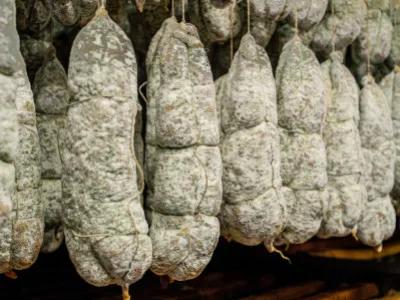
A fine layer of white or slightly bluish mould is entirely normal and even sought after. It's known as the saucisson's bloom.
This natural mould plays a protective role:
- It regulates humidity and stops the saucisson from drying out too quickly.
- It limits the growth of unwanted bacteria.
- It contributes to the ageing of the product and the development of its flavours.
This is why most artisanal saucissons naturally develop it, especially when stored in a slightly humid and well-ventilated environment.
What should you do? Nothing at all! Simply brush off the bloom lightly or wipe it with a dry cloth before tasting if it bothers you.
The bad mould: signs of a problem
If your saucisson has green, yellow or black mould, this may indicate excess humidity or poor air circulation. This mould can affect the taste of the saucisson and, in some cases, make it unfit for consumption.
Here are a few signs that should put you on alert:
- Green mould: often caused by excessive humidity, it can be removed if only slightly present.
- Black or dark brown mould: may indicate contamination by unwanted fungi, so it's best not to eat the product.
- Unpleasant or ammonia-like smell: if the smell is strong and unusual, the saucisson has probably gone off.
- Slimy texture: a saucisson that's too moist and sticky is no longer fit to eat.
How do you clean a mouldy saucisson?
If your saucisson has suspicious patches but is otherwise in good condition, here are several methods for cleaning it and making it fit to eat again.
Method 1: Dry brushing
Take a clean cloth or a vegetable brush and gently rub the surface of the saucisson to remove the mould. This technique works well on light white and green moulds.
Method 2: White vinegar
Mix a little white vinegar with water, soak a cloth in it and wipe the saucisson with this mixture. Vinegar acts as a natural disinfectant and effectively eliminates mould.
Method 3: Food-grade alcohol
You can also use a cloth lightly soaked in cognac, armagnac or rum to clean the surface of the saucisson, which will also give it a subtle woody aroma.
Method 4: Flour or semolina
After cleaning, you can roll the saucisson in flour or fine semolina to give it a drier appearance and prevent mould from coming back.
If, despite these treatments, your saucisson still gives off an unusual smell or has an odd texture, it's best not to eat it.
How can I stop my saucisson from going mouldy?
The best way to prevent unwanted mould from appearing is to follow good storage practices.
Don't seal the saucisson in an airtight wrapping
The saucisson needs to breathe! Avoid plastic bags, which trap moisture and encourage the growth of harmful mould.
Store the saucisson in a dry, well-ventilated spot
Ideally, it should be kept in a well-aired cupboard, a cellar, a larder, or the drawer of your fridge, at a temperature no higher than 15°C, with controlled humidity.
Wrap it in a tea towel or butcher's paper
A saucisson left too exposed to the air can dry out too quickly, whilst excess humidity encourages mould. The best approach is to wrap it in a clean tea towel or butcher's paper.
Hanging the saucisson
If you have several saucissons, hang them with string in a dry, well-ventilated spot. This limits contact with humidity and allows for more even ageing.
Checking its condition regularly
A quick glance from time to time allows you to spot any unusual mould appearing early on and act before it takes hold.
Conclusion
A mouldy saucisson isn't necessarily one to throw away! If the mould is white or slightly bluish, it's entirely normal and can simply be wiped off before tasting. However, if it's green, black, or gives off a bad smell, this may be a sign of a storage problem.
With a few simple habits, such as storing it in a dry, airy spot, using suitable wrapping and checking on it regularly, you can prevent your saucisson from becoming excessively mouldy. And if it does happen, a simple wipe with a cloth, vinegar or food-grade alcohol can often save it.
So don't panic at the sight of a mouldy saucisson: observe, clean and enjoy with complete peace of mind!
Discover all our charcuterie here.
Les Têtes de lard