Charcuterie with friends
Difference between industrial and artisanal charcuterie
Charcuterie is an integral part of French gastronomic heritage. From dry-cured ham to rosette, not forgetting dry sausage and saucisson, enthusiasts delight in these…
8 min read· By Alex Foras
Difference between industrial and artisanal charcuterie: understanding the issues and making the right choice
Charcuterie is an integral part of French gastronomic heritage. From dry-cured ham to rosette, not forgetting dry sausage and saucisson, enthusiasts delight in these typical products. But between industrial charcuterie and artisanal charcuterie, the differences are major, whether in terms of taste, production methods, quality of ingredients or health impacts. In this article, we shall look in depth at these two types of charcuterie in order to better understand their characteristics, their advantages and their drawbacks.
Defining industrial and artisanal charcuterie
What is industrial charcuterie?
Industrial charcuterie is produced on a large scale in food processing factories. These products are often destined for large-scale retail. The volumes manufactured are very substantial, and standardisation of recipes and processes is the rule. To optimise production and reduce costs, manufacturers make use of additives, preservatives, flavour enhancers and nitrites. This industrialisation makes it possible to produce millions of items each year with impressive uniformity, but it raises questions about the quality and traceability of the raw materials.
In addition to additives, manufacturers sometimes include artificial flavourings to boost taste and compensate for the absence of natural maturation. The process is often assisted by cutting-edge technologies that save time, but which sometimes alter the true nature of the product.
What is artisanal charcuterie?
Artisanal charcuterie is made in small quantities by charcutier craftsmen. Know-how, rigorous selection of raw materials, and a commitment to traditional methods lie at the heart of their work. Recipes vary from one craftsman to another, and the products are often more authentic, with a reduced, or even non-existent, presence of chemical additives.
The artisanal approach favours personalisation and respect for natural maturing times. Each product is unique and may vary slightly according to the seasons, the raw materials and the techniques used by the charcutier. This diversity contributes to the taste and cultural richness of artisanal charcuterie.
Manufacturing processes: a fundamental difference
Industrial production: standardisation and speed
In industrial production units, manufacturing time is optimised to meet mass demand. The hams cook quickly, saucissons dry in a matter of days thanks to advanced technologies, and chemical agents help speed up the processes. Machines handle almost the entire manufacturing process, and human involvement is limited to supervising and monitoring the production line.
This pursuit of speed allows industrial producers to offer competitive prices, but at the cost of losing certain organoleptic qualities. Industrial techniques rely on accelerated drying chambers, brine injections and calibrated mixes that make the products uniform.
Artisanal production: time, patience and know-how
By contrast, artisanal charcuterie respects long maturing times. Dry-cured ham, for instance, may dry for several months, or even years. Saucissons dry slowly under natural or semi-natural conditions. The artisan follows each stage with great care, checks on the products' progress, and adjusts the temperature and humidity as needed. Human know-how is essential in ensuring the final quality.
This approach calls for constant attention and a genuine love of the craft. The artisan may step in by hand to correct a stage or bring out the best in a product. This long, painstaking process helps create complex, authentic flavours.
The quality of the ingredients: a decisive factor
Industrial ingredients: origin and composition
Industrial producers often source their meat from intensive farms, where traceability and animal welfare are not always a priority. To ensure a long shelf life and a uniform appearance, industrial manufacturers add nitrites, preservatives, colourings and artificial flavourings.
Raw materials are generally chosen for their low price and ease of supply. The meat may come from various countries and be blended together without any clear indication for the consumer. This lack of transparency fuels mistrust and criticism of industrial charcuterie.
Artisanal ingredients: selection and transparency
Artisan charcutiers, on the other hand, often source their supplies from local farmers or carefully controlled supply chains. They prefer to use higher-quality meats, sometimes from organic farming or free-range rearing. The recipes are simpler and more transparent: salt, pepper, natural spices, and an almost complete absence of additives.
This rigorous selection of raw materials contributes directly to the quality of the finished product. Artisans favour pigs that are fed healthily and reared in better conditions, giving a tastier and healthier meat.
The impact on health
The risks linked to industrial charcuterie
The presence of nitrites and chemical additives in industrial charcuterie lies at the heart of many controversies. Studies have shown a link between excessive consumption of nitrites and certain cancers, notably colorectal cancer. What's more, the salt and saturated fat content is generally higher in these products.
Excessive consumption of industrial charcuterie may also encourage cardiovascular disease and high blood pressure. While these products remain permitted and widely eaten, health authorities recommend limiting their regular consumption.
The health benefits of artisanal charcuterie
Whilst not entirely free of salt or fat, artisanal charcuterie generally remains healthier thanks to the reduced use of additives and preservatives. The choice of quality ingredients, mastery of recipes and artisanal know-how make it possible to offer products that are often better tolerated and have a more balanced nutritional profile.
The transparency of artisan producers helps consumers better understand what they are eating. Some artisans even offer nitrite-free recipes or those with reduced salt levels, meeting a growing demand for healthier products.
Taste and texture: undeniable differences
The taste of industrial products
Industrial charcuterie tends to offer standardised flavours, suited to the widest possible audience. The texture is often uniform, sometimes soft, and the flavour lacks character. The aim is to guarantee an identical product from one batch to the next.
This homogenisation aims to satisfy consumers accustomed to consistent flavours, but it limits the richness of taste. Artificial smoking aromas and flavour enhancers sometimes mask the mediocre quality of the base meat.
The taste of artisanal products
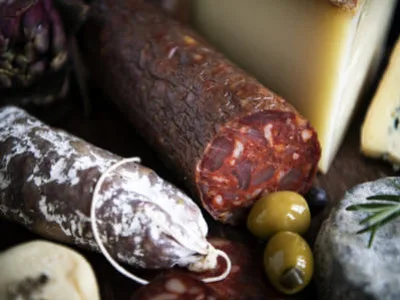
Artisanal products offer more complex aromas, varied textures and distinct nuances of flavour. Each ham, each saucisson has its own signature. The extended drying time, the use of natural spices and manual craftsmanship bring an incomparable sensory richness.
The texture of an artisanal saucisson can vary between the centre and the outer edge, a sign of slow, carefully controlled drying. The flavours are often more intense and evolve as you taste, offering a truly gastronomic experience.
Economic and environmental aspects
The price of industrial charcuterie
Produced in large quantities and with optimised costs, industrial charcuterie is generally more affordable. It can be found in supermarkets, hypermarkets and discount chains. Its low price makes it an accessible product, but this often comes at the expense of quality.
This accessibility can encourage overconsumption, particularly among young people and lower-income households. However, consumers are increasingly turning away from these cheap products in favour of more authentic ones.
The price of artisanal charcuterie
Artisanal charcuterie is more expensive, as it requires more time, higher-quality ingredients and specific know-how. This higher price reflects the quality of the product, the sustainability of supply chains and fair pay for the craftspeople involved.
This higher price is also a reflection of a fairer economy, one that values short supply chains and properly remunerates each player in the industry, from farmer to charcutier.
Environmental impact
Industrial charcuterie has a heavier environmental impact, notably due to international logistics, the massive use of plastic packaging and intensive farming. Long-distance transport generates a significant carbon footprint, and intensive production places heavy demands on natural resources.
Artisanal charcuterie, with its short supply chains and greater respect for natural resources, generally forms part of a more eco-responsible approach. The proximity of suppliers reduces transport and encourages more sustainable, environmentally friendly farming.
Labels and certifications: how to find your way around?
Labels can help distinguish quality products. Industrial charcuterie sometimes carries labels, but these can be misleading. Artisanal products, on the other hand, can benefit from more demanding labels such as:
- Label Rouge: a mark of superior quality.
- IGP (Indication Géographique Protégée): guarantees geographical origin and local know-how.
- Organic: certifies production free from pesticides and with stronger animal welfare standards.
Other certifications can also provide additional guarantees, such as "Produit Fermier" or "Viande de Porc Français". It is best to check the origin, composition and traceability in order to make an informed choice.
Why choose artisanal charcuterie?
For the taste and superior quality.
To support local producers.
- To limit exposure to chemical additives.
- To contribute to more responsible consumption.
- To preserve age-old know-how.
- To take part in a fairer local economy.
Artisanal charcuterie, as well as being delicious, is often synonymous with human values, respect for tradition and a commitment to quality. It also allows us to rediscover regional specialities that have sometimes been forgotten, and to promote age-old recipes.
Tête de Lard, a committed selection
At Tête de Lard, we choose to support small, committed producers – those who work with passion, respect tradition and favour more natural methods. We strive to select our charcuterie rigorously so as to offer you quality products, with complete transparency. Our aim: to let you enjoy good artisanal charcuterie without having to ask yourself any questions.
Whilst we don't exclusively offer nitrite-free charcuterie, we are proud to offer the largest online selection of nitrite-free charcuterie. A unique choice for those who wish to enjoy healthier products without compromising on taste.
By choosing Tête de Lard, you are supporting a more responsible approach and authentic know-how, and above all, treating yourself with complete confidence.