Charcuterie with friends
Black pork of Bigorre
Black pork has always populated the landscapes of Bigorre. Yet in 1981, only a few rare specimens remained. Today it once again roams the woodlands and grassy pastures of small free-range farms, and the…
7 min read· By Rémi Ledu
From extinction … to exception,
Black pork takes centre stage
Curious and endearing
The animal
Specifications
Its native homeland
Tradition and natural rearing
The Noir de Bigorre Ham
A unique ham
Black pork takes centre stage
Black pork has always populated the landscapes of Bigorre. Yet in 1981, only a few rare specimens remained. Today it once again roams the woodlands and grassy pastures of small free-range farms, feeding on rye and barley and, in season, eating its fill of grass, acorns and chestnuts, of which it is particularly fond. It is given all the time needed for its natural growth cycle, a minimum of 12 months, and develops real flavour!
An exceptional breed, exceptional rearing…
Made up of small herds, these free-range farms blend into a preserved environment that respects the ecosystem.
Noir de Bigorre pork is part of the history, the culture, the landscape.
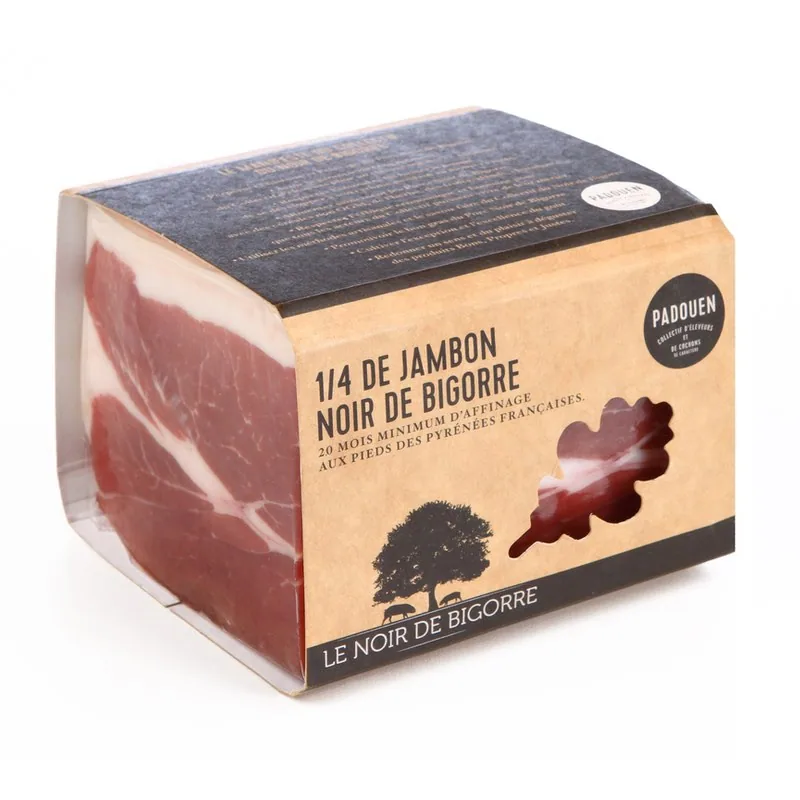
Just the right amount of salt from the Adour Basin stimulates the palate, enhances the flavours, and this ham becomes a true work of art! Its finely marbled, slightly glossy flesh is a sign of a fine taste to come. Its minimum of 18 months of ageing allows its full aromatic potential to unfold.
Like a great wine, Noir de Bigorre is best enjoyed at room temperature.
Curious and endearing
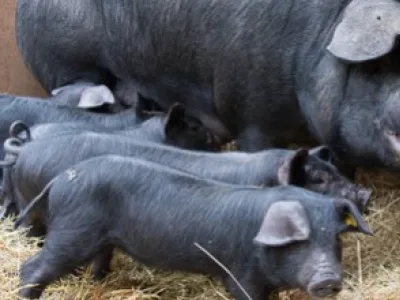
On the farms, the Black Pork lived alongside the other farmyard animals and was taken out to pasture every day. As a result, through regular contact with the farmers, it developed a calm and familiar nature, shown through its docility and curiosity. It is a truly endearing animal, carefully looked after by farmers who observe its behaviour in its natural surroundings and take particular care to give it the best possible rearing conditions. In doing so, the farmers naturally rediscover their calling as “stockmen”, a hallmark of those who once raised animals in the Pyrenees.
The animal
The Noir de Bigorre is a purebred Gascon pig, born of breeding stock registered in the herd book, reared within its historic geographical area at the foot of the Pyrenees, in its natural setting of meadows and woodland, following an age-old rearing method.
Its coat is entirely black – the snout and trotters are black too. As an adult, it stands around 0.75 m tall. The body is cylindrical and the ham is particularly well formed, thick and round. The leg bones are rather fine, yet very dense, as hard as ivory. The muscles are very well developed at the shoulders and rump. The head is slender and very long, especially the facial part, straight and pointed, ending in a small, sturdy and highly mobile snout, which allows it to root about in the ground in search of food. The ears are of medium length, not very fleshy, rather narrow, then slightly splayed towards the tips, carried horizontally or slightly tilted.
The Noir de Bigorre is hardy and vigorous, extremely resilient, and an excellent walker.
Specifications
• The territory straddling the Hautes Pyrénées, Haute Garonne and Gers
• The animals are purebred Gascon
• Feed made up of 70% non-GM cereals (barley, wheat, triticale)
• The sows go out to pasture every day
• The piglets are reared in buildings with straw bedding, or out in the meadows, with shelters
The pigs are fattened in the meadows and woodland for at least the last 6 months of their fattening period
The number of animals must be fewer than 25 per hectare
The pigs are slaughtered at 12 months of age.
Its birthplace
The production area of the Noir de Bigorre extends across the Hautes Pyrénées department, the Comminges area in Haute Garonne, the neighbouring cantons and the Astarac in Gers.
This area corresponds to the historic birthplace of the breed, and has particular characteristics which explain its presence there:
- a temperate climate with rainfall well spread across the seasons – very little wind and mild temperatures that allow the animals to be reared outdoors
- suitable terrain: wooded hills, sheltered valleys or hillsides, with the steeper Western slopes, home to chestnut and pedunculate oak trees, dedicated to rearing
- a region of pastures, where animals of all kinds were once led out to graze by the children or grandparents, small farming properties and a peasant economy based on mixed farming and livestock rearing, in which pig production held an essential place;
- the foehn, a wind from Spain that cools as it crosses the Pyrenees and blows alternately with the wind coming from the Atlantic, thereby allowing the hams to be aged.
Tradition and naturalness
The farmers and partners in the trade, keen to preserve the great quality of this heritage, have chosen to maintain traditional rearing conditions. The breeding sows can feed 8 to 10 piglets, which they give birth to twice a year. The piglet suckles from its mother for 5 to 6 weeks before being weaned; by then it already weighs 8 kilos. It is then reared either in pig housing with straw bedding, or in meadows fitted with shelters. Later, once it reaches 3 to 6 months of age, it can go and roam freely across meadowland or woodland.
With no more than 25 to the hectare, the Black Pigs feed daily on meadow grass made up of clover and grasses, as well as cereals (barley, triticale, wheat, rye) most often mixed with peas. All raw materials must be non-GMO. Depending on the season, the pigs eat acorns, beechnuts, chestnuts and whatever they come across while rooting in the soil.
They are slaughtered at a minimum age of 12 months (14 months on average). At that point, they weigh around 160 kg.
Jambon Noir de Bigorre
The Jambon Noir de Bigorre is best enjoyed at room temperature (between 20 and 22°C), savoured between tongue and palate. Cut into thin slices, it melts, revealing gentle, lingering flavours on the palate.
Jambon Noir de Bigorre contains 51% monounsaturated fatty acids, including 47% oleic acid. It is rich in antioxidants and boasts all the virtues of the emblematic products of the Mediterranean diet. As gourmets well know, fat lies at the heart of flavour transmission and keeps the taste alive in the mouth.
A unique ham
How the ham is made
4 steps to create a unique ham
The ageing of Jambon Noir de Bigorre takes place in the very same area where the pigs are reared, at the foot of the Pyrenees
Salting: the hams are covered with dry rock salt from the Adour Basin saltworks, to ensure their preservation. The salting time is determined according to the weight of the ham, in order to achieve a gentle salting. The salt contributes to the development of the aromas and the intensity of the colour so distinctive of Jambon Noir de Bigorre.
Cold resting: during this stage, the ham is hung and left to mature at a low temperature for between 10 and 16 weeks. Over this period, the salt spreads evenly and the ham loses moisture.
Drying: after the cold resting period, the hams move into the drying rooms at ambient temperature, up to 10 months of age. During drying, the hams are covered with fat on the lean part, to achieve an even drying of the slice.
Ageing: the Jambon Noir de Bigorre hams spend at least the final 10 months of the cycle in a drying room fitted with windows, allowing outside air to enter and circulate, so the hams can age under natural conditions of temperature and humidity. In this way, they benefit from the quite distinctive “foehn effect*” of the Piedmont region of the central Pyrenees.
*Le foehn est le vent du sud, plus sec et chaud, qui souffle dans la région 1 jour sur 3 ou 4, en alternance avec le vent plus froid et humide venant de l’Atlantique. C’est au cours de cette phase d’affinage que le jambon acquiert toutes ses caractéristiques sensorielles et développe sa typicité.
On réalise un sondage olfactif sur 3 points différents du jambon afin de contrôler sa qualité.
En vraie Tête de lard que vous êtes, partez à la rencontre de cette viande extraordinaire.
Source : Collectif PADOUEN